

Moers-Asberg

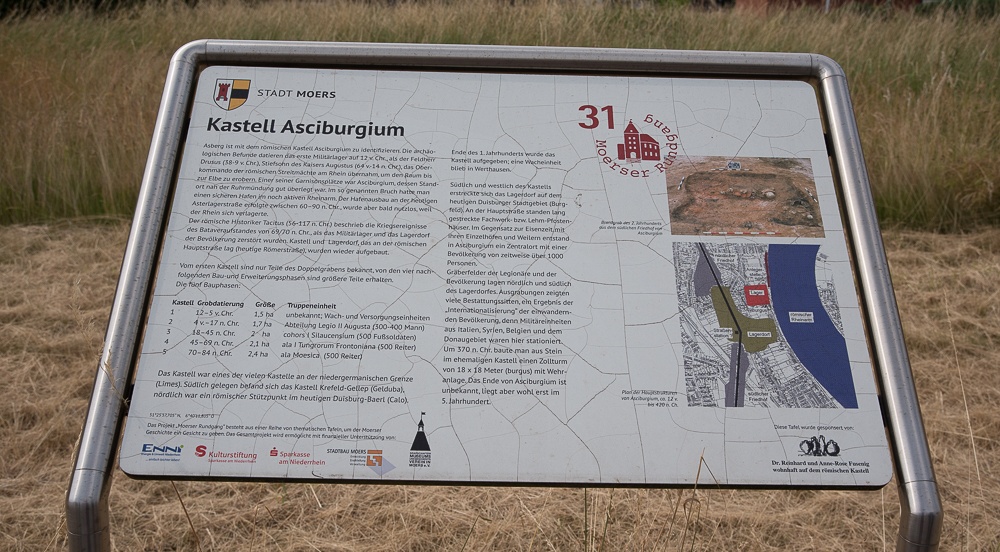
Eine Informationstafel in Moers-Asberg als Hinweis auf den ehemaligen Lagerbereich.
Image:

Information boards draw attention to the existence of an auxiliary camp in Moers-Asberg.

Auxiliary camp at Asciburgium

The Asciburgium auxiliary camp that was excavated in present-day Moers-Asberg provides evidence of how auxiliary soldiers were housed along the Lower Germanic Limes during the early days of the Empire. The camp was established around15/16 AD and enclosed by a rampart of earth and timber and a double ditch construction. No evidence dating from this period has been found of buildings inside the fort, indicating that the soldiers were probably housed in tents. The first solid structures were erected around the middle of the first century AD and housed a cavalry unit. Following a period of abandonment, the Later Roman Empire saw the site being used for the construction of a strong fortified tower, or burgus. The area of the camp has since largely been built over.

Access: private and public

Note:
The archaeological remains that make up the Lower Germanic Limes (NGL) UNESCO World Heritage Site are all very well preserved. Most of these structures are buried underground and well protected. Some are visible above ground. So far, there is very little on-site information explaining the history and significance of these finds. We are currently working on a comprehensive package of information and presentation resources to promote public understanding of these sites.
The best Roman sites near you
The best Roman sites in North Rhine-Westphalia

Meilenstein

Bergheimer Straße
53909 Zülpich
Deutschland

N 50°42'8" E 6°39'29"
> Learn more

Abschnitt Via Belgica: Nivelsteiner Sandwerke

Wildnis 78
52134 Herzogenrath
Deutschland

Sandsteinabbau seit der Römerzeit

N 50°53'23" E 6°5'0"
> Learn more

Abschnitt Via Belgica, römische vici, Straßenstation

L 136
52457 Aldenhoven
Deutschland

Vier Kilometer langer Abschnitt der römischen Via Belgica durch das heutige Aldenhoven, der exakt dem antiken Straßenverlauf entspricht.

N 50°52'43" E 6°14'6"
> Learn more

Badehaus einer villa rustica

Naherholungsgebiet Wurmtal, In der Schley 70
52531 Übach-Palenberg
Deutschland

Überreste des Badehauses eines römischen Gutshauses aus dem 2./3. Jh. Bild: Andreas Hillebrecht, CC BY-SA 3.0

N 50°55'48" E 6°5'35"
> Learn more

Villa rustica Roderath

Villa Rustica, K 36,
53947 Nettersheim
Deutschland

Überreste einer römischen Hofanlage, bestehend wohl vom 1.-4. Jh. n. Chr.

N 50°30'12" E 6°41'41"
> Learn more

Brunnen

Europaschule, Raderthalgürtel 3
50968 Köln
Deutschland

Seit 2011 in der Schule sichtbar gemachter römischer Brunnen des 2. Jh., der zu einem Landgut gehörte.

N 50°54'10" E 6°57'1"
> Learn more

Abschnitt Via Belgica

Kaeks
52382 Quadrath-Ichendorf
Deutschland

Die Via Belgica war die römische Fernstraße von Köln nach Boulogne-sur-Mer. Etwa 60 Kilometer der Straße liegen im heutigen Rheinland. Sie verläuft von dort durch die niederländische Provinz Zuid Limburg über die Wallonie in Belgien bis zur Küste an den Ärmelkanal.

N 50°56'7" E 6°40'49"
> Learn more

Wachtturm?

Römische Wall-Graben-Anlage, Promenade
33604 Bielefeld
Deutschland

Unvollendete Anlage aus der Zeit der Drususfeldzüge 11-9 v. Chr. Der Außendurchmesser des Kreisgrabens betrug 32 m, der der rekonstruierten Innenfläche 24 m. Es gab keine Innenbebauung.

N 52°0'31" E 8°32'13"
> Learn more

Radroute „Via Romana“

Wirtschaft, Tourismus & Marketing Stadt Kleve GmbH
Minoritenplatz 2
47533 Kleve
Deutschland

Die ca. 260 km lange Route „Via Romana“ Rad-Touristen durch 2.000 Jahre Geschichte, entlang der niederrheinischen Naturlandschaften, vorbei an mittelalterlichen Stadtkernen, sehenswerten Museen bis hin zu Parkanlagen und Schlössern. Startpunkte sind die ehemaligen Römersiedlungen Ulpia Noviomagus Batavorum – heute Nijmegen, die älteste Stadt der Niederlande – und die Colonia Ulpia Traiana bei Xanten.

N 51°47'52" E 6°8'39"
> Learn more

Gräberfeld

Am Alten Bahnhof
50354 Hürth-Hermülheim
Deutschland

Gräberfeld mit 45 Bestattungen aus dem 3.-5. Jh. N. Chr.

N 50°52'45" E 6°53'29"
> Learn more
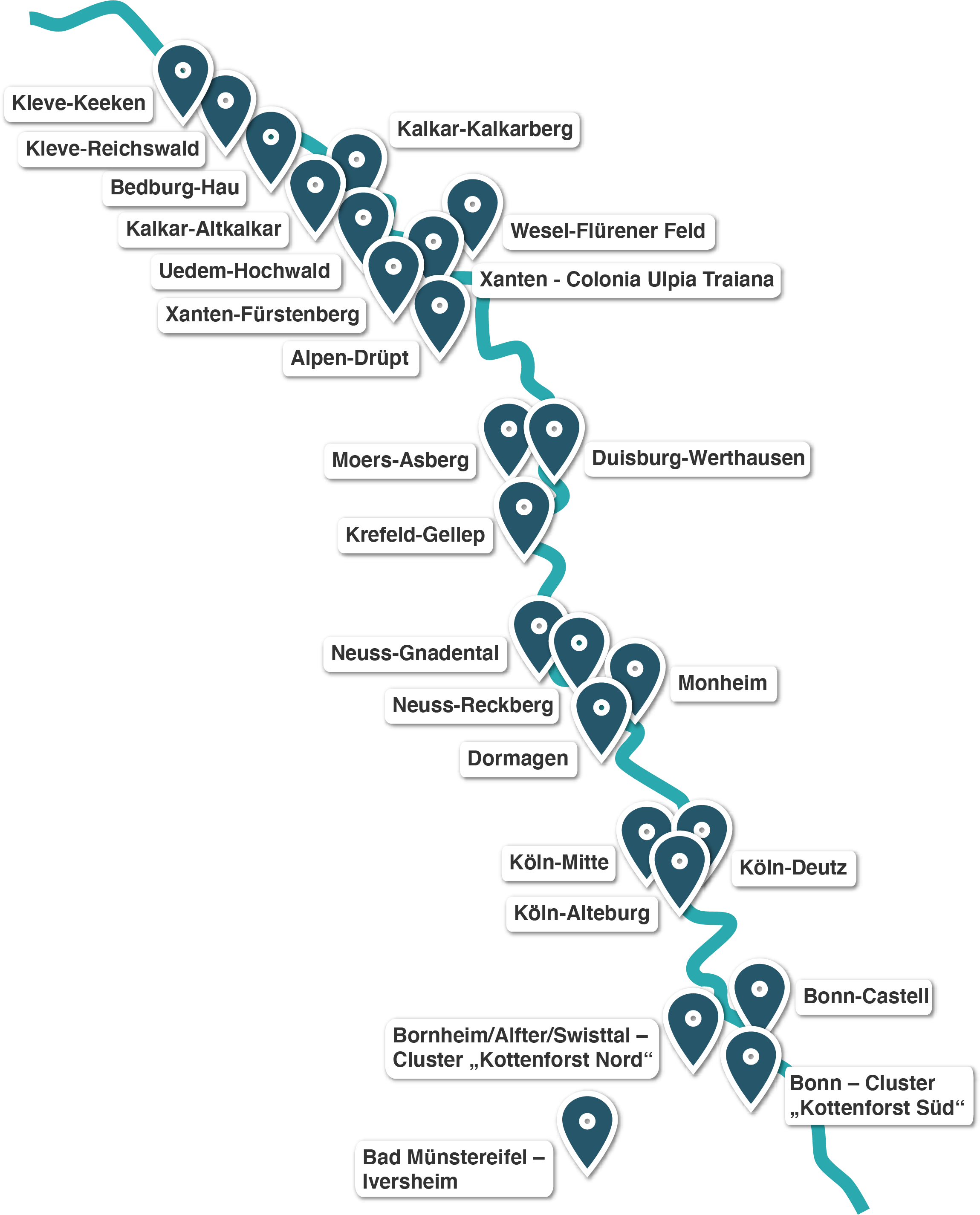
The towns and cities along the Limes in North Rhine-Westphalia
Kleve-Keeken Kleve-Reichswald Bedburg-Hau Kalkar-Kalkarberg Kalkar-Altkalkar Uedem-Hochwald Wesel-Flürener Feld Xanten - Colonia Ulpia Traiana Xanten-Fürstenberg Alpen-Drüpt Moers-Asberg Duisburg-Werthausen Krefeld-Gellep Neuss-Gnadental Monheim Neuss-Reckberg Dormagen Köln-Mitte Köln-Deutz Köln-Alteburg Bonn-Castell Bornheim/Alfter/Swisttal/ Cluster Bonn - Cluster Bad Münstereifel - Iversheim